How the Right Community Transforms Individual Ambition into Collective Acceleration
You’ve been grinding solo for so long that you’ve almost forgotten what it feels like to have people truly get it.
Your family is supportive, but they don’t understand the specific challenges of your industry. Your peers are friendly enough, but you’re competing with them for the same promotions and opportunities. Your boss is professional, but admitting vulnerability or uncertainty to them feels risky. Your mentors are helpful when you can reach them, but they’re busy with their own lives.
So you process everything internally. You Google problems at midnight. You read business books looking for answers. You reach out to acquaintances when you need advice, but the advice is generic because they don’t know your specific context. You celebrate wins alone and process failures alone.
It’s lonely. Even when you’re surrounded by colleagues, there’s a fundamental loneliness that comes from processing ambition, uncertainty, and growth in isolation.
This loneliness has a cost. It shows up as anxiety when you’re not sure if you’re making the right decision. It shows up as imposter syndrome when nobody around you is sharing their doubts. It shows up as burnout when you’re carrying everything alone. It shows up as missed opportunities when you don’t have people reflecting back what you can’t see about yourself.
But here’s what you’re probably not expecting: The loneliness isn’t inevitable. Neither is the isolation.
There’s another way.
The Problem With Doing This Alone
Most ambitious young professionals follow a similar pattern: They believe their success depends on their individual effort, intelligence, and luck. They think if they just work hard enough, figure things out fast enough, and make the right choices, they’ll succeed.
This belief has a hidden cost.
It amplifies anxiety: When success depends entirely on you, every decision carries existential weight. Every mistake feels catastrophic because there’s nobody sharing the load. The pressure creates anxiety that actually impairs decision-making.
It hides blind spots: You can’t see what you can’t see. When you’re processing everything alone, the blind spots remain blind. You make decisions based on incomplete information without realizing you’re missing context.
It reduces innovation: The best ideas come from dialogue. When you’re thinking alone, you’re limited to your own mental models. When you’re thinking with others, you get access to different mental models that generate better solutions.
It creates repetitive mistakes: Everyone makes mistakes. Wisdom comes from learning from those mistakes. But if you’re the only person processing your mistakes, you only learn from the limited set of mistakes you’ve personally made. When you’re in community with others, you learn from dozens of mistakes you didn’t have to make yourself.
It kills momentum: Ambition without social accountability is volatile. You get fired up about something one week and it fades by the next. You commit to a goal and lose momentum when you hit obstacles. Momentum is multiplied when you’re in community—other people’s commitment pulls you forward when yours is lagging.
It’s inefficient: There are hundreds of people who’ve solved the exact problem you’re facing right now. If you could find them and understand their solution, you’d save months. Instead, you’re solving it alone, reinventing wheels, making mistakes people solved years ago.
Doing this solo isn’t noble. It’s inefficient. It’s lonely. And it’s unnecessary.
What Happens When You Stop Being Alone
Now imagine something different. Imagine being part of a community of people at your career stage who are navigating similar challenges. Not competing with you for the same job, but working in different industries, different functions, different cities. People who get what you’re trying to do without you having to explain it.
Imagine posting a challenge you’re facing and getting responses from three different people who faced something similar and learned from it. Not generic advice—specific wisdom from people in contexts adjacent to yours.
Imagine having a group of peers who you check in with weekly. Who celebrate your wins. Who listen when you’re uncertain. Who reflect back what they see in you that you can’t see in yourself. Who call you out when you’re not being as bold as you could be. Who support you when you’re being bold and failing.
Imagine being part of conversations where everyone is honest about their doubts and their ambitions. Where vulnerability isn’t weakness—it’s the price of entry. Where you don’t have to pretend to have it figured out because nobody does.
Imagine having access to experienced mentors who work with your community collectively. Who understand the common challenges you’re facing. Who share frameworks that apply across different contexts. Who connect you with other community members when they see alignment.
Imagine being part of something bigger than your individual career. An ecosystem where you’re not just pursuing your own success but contributing to the collective success of your community. Where your wins energize others. Where other people’s breakthroughs inspire you.
This isn’t theoretical. This is what the 100x TRIBE ecosystem creates.
The 100x TRIBE: What It Actually Is
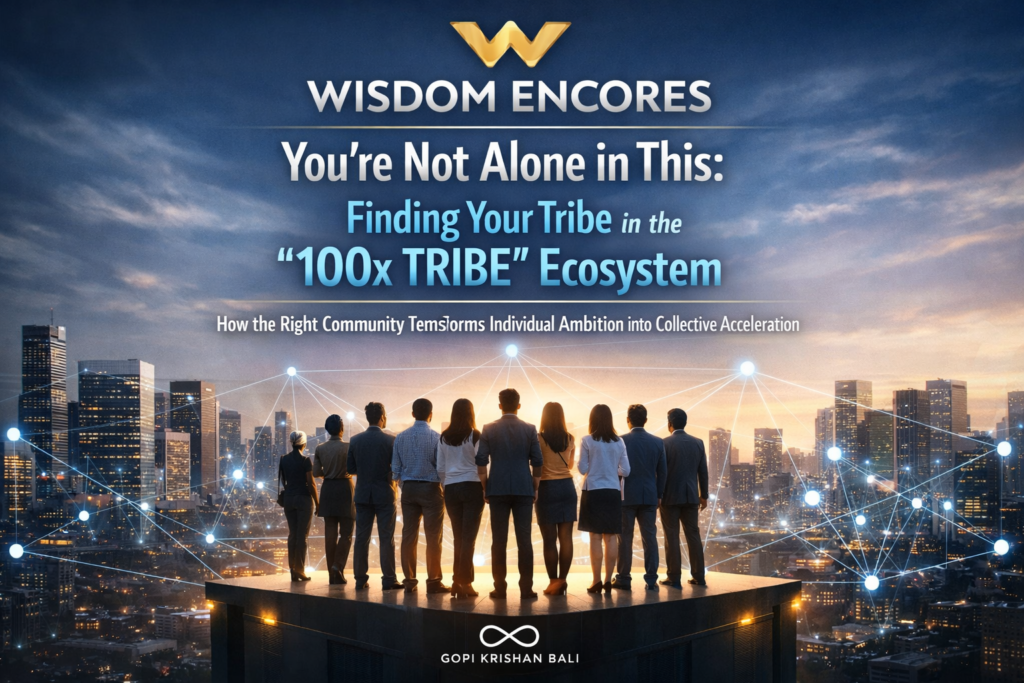
The 100x TRIBE isn’t a networking group. It’s not a mastermind where everyone talks about their goals. It’s not a course disguised as a community.
It’s an ecosystem of young professionals (and mentors) committed to accelerating each other’s trajectories through genuine connection, radical honesty, and collective wisdom.
Here’s what makes it different:
Radical Honesty
In the 100x TRIBE, you don’t have to pretend you’ve got it figured out. You’re not performing. You’re not managing your image. You’re being real about your doubts, your failures, your uncertainties, and your ambitions.
This honesty creates psychological safety. When everyone is admitting they’re figuring things out, you stop feeling like an imposter. When everyone is sharing doubts, you stop feeling like you’re the only one uncertain. When everyone is honest about their struggles, you realize you’re not uniquely broken—you’re normally human.
And when people are honest, the advice they give is actually useful. They’re not trying to impress you with answers. They’re thinking alongside you about what might actually work.
Cross-Functional Diversity
The TRIBE includes people across different industries, functions, career stages, and geographies. A product manager in fintech, a software engineer in healthcare, a marketing executive in nonprofits, a founder building a B2B company, a consultant navigating their second job.
This diversity is the secret sauce. Because your problem in healthcare has probably been solved by someone in fintech. Your question about career transitions has probably been navigated by someone in a completely different industry. Your uncertainty about a decision has probably been wrestled with by peers in contexts that illuminate your situation.
The cross-functional diversity means you have access to wisdom from hundreds of different mental models instead of just your own.
Mentorship Embedded in Community
Experienced professionals who join the TRIBE aren’t there to be separate authority figures. They’re embedded in the community. They’re in group conversations, responding to questions, sharing frameworks, introducing people.
This creates a different dynamic than traditional mentorship. Instead of waiting for a scheduled 1:1, you get access to mentors in real time. Instead of thinking alone and then bringing questions to mentors, you’re thinking alongside your community and mentors simultaneously. Instead of mentors being scarce resources, mentorship is woven throughout the ecosystem.
Accountability Without Judgment
The TRIBE creates accountability through connection, not through judgment. You share what you’re working toward. Your community knows what you committed to. When obstacles emerge, they’re asking how you’re thinking about them. When momentum lags, they’re reflecting back that you’re capable.
This accountability actually works because it’s wrapped in genuine care. People aren’t keeping score. They’re committed to your success. And that commitment pulls you forward.
Paid Forward Generosity
As people in the TRIBE progress, they don’t exit. They stay connected and contribute back. The software engineer who became a tech leader helps newer engineers navigate that same transition. The founder who built a successful company helps younger people think through their ideas. The person who navigated a major career transition helps others contemplating similar moves.
This creates a compounding effect. The wisdom doesn’t stay with individuals—it spreads through the community. And as it spreads, everyone accelerates.
How the TRIBE Actually Works in Practice
Understanding the concept is one thing. Understanding how it actually works is another.
The Regular Practices
Cohort Calls: Small groups of 8-12 TRIBE members meet weekly or biweekly. You come with whatever’s on your mind—challenges, questions, celebrations, doubts. You think through things together. You get perspective from people who aren’t emotionally invested in your specific situation but genuinely care about your success.
Thematic Workshops: Experienced professionals facilitate workshops on specific topics relevant to where the community is. Career transitions, difficult conversations, fundraising, product strategy, leadership. These aren’t lectures—they’re interactive, grounded in real situations people are facing.
1-on-1 Matches: The TRIBE matches people based on complementary needs. A person navigating a technical leadership transition gets connected with someone who made that journey. A person building a company gets connected with a founder who’s been through multiple rounds of fundraising.
Async Community Space: A platform where people share wins, ask questions, share resources, have conversations. The daily rhythm of small interactions that build community.
Annual Gathering: Once a year, the community comes together in person. You meet people you’ve been in community with online. You deepen connections. You celebrate collectively. You recalibrate together on what matters.
The Unspoken But Powerful Norms
Beyond the formal structures, the TRIBE operates on certain norms that make it work:
Vulnerability is valued more than perfection: People are more respected for being honest about what they don’t know than for pretending to have it figured out.
Paid forward help is the norm: People who get supported early become supporters of people coming later. The ecosystem grows because generosity is built in.
Diversity of thought is sacred: Disagreement is valued. There’s no single right way to think about anything. Multiple perspectives make everyone smarter.
Action is the real test: You’re not valued for thinking or talking about what you’re going to do. You’re valued for actually doing it and learning from it.
Celebrating others’ wins is celebrating your own: There’s no scarcity in the TRIBE. Someone else’s promotion doesn’t mean less for you. Everyone’s growth strengthens the whole.
What People Actually Experience in the TRIBE
Let’s look at what happens in practice:
The Belonging
For the first time, you’re surrounded by people who genuinely get what you’re trying to do. They don’t think you’re crazy for being ambitious. They don’t diminish your challenges. They don’t offer unsolicited advice about “settling” or “working less.” They understand the hunger to build something, to grow, to become.
This belonging doesn’t solve everything. But it changes what loneliness feels like. When you fail, you fail surrounded by people who’ve failed similarly. When you succeed, you succeed surrounded by people who celebrate you without resentment. When you’re uncertain, you’re uncertain in community.
The Acceleration
Within a few months, you notice you’re making decisions faster. Not recklessly, but more confidently. You’re seeing around corners because people in your community have seen those corners. You’re avoiding mistakes because you’ve learned from mistakes others made. You’re moving forward instead of stalling in uncertainty.
The Expanded Network
Your network doesn’t just grow, it multiplies. Through your TRIBE connections, you’re introduced to people you’d never have found alone. Some become collaborators. Some become close friends. Some introduce you to opportunities. Your network becomes an asset instead of a contact list.
The Clarity
You start understanding what matters to you more clearly. Not because anyone told you, but because being in community with people who are serious about their own paths makes you serious about yours. You start making choices aligned with your actual values instead of default expectations.
The Resilience
You bounce back from failures faster. You don’t internalize setbacks as identity crises because your community has context for them. You’re more willing to take risks because you have people who’ll support you regardless of outcome.
The Compounding Growth
The frameworks you learn apply across contexts. The confidence you build in one domain transfers to others. The relationships you develop become resources for multiple challenges. Everything compounds because you’re not starting fresh on each challenge — you’re building on what you’ve already learned in community.
The Types of People in the TRIBE
The TRIBE isn’t monolithic. It includes:
The Ambitious Early Career People: 2-5 years in, hungry to move fast, figuring out their professional identity. Often in their late twenties to mid-thirties.
The Career Transitioners: People moving functions, industries, or roles. Everyone from first-time managers to people reinventing after 10 years in the same space.
The Entrepreneurs: People who’ve left corporate or are working toward leaving. Building something of their own.
The Leaders: People in leadership roles trying to figure out how to lead effectively, build teams, make strategic decisions.
The Mentors: Experienced professionals who remember being where younger people are and want to help. Often working part-time or in encore roles.
The Returners: People coming back after time away—parental leave, time off, sabbatical. Recalibrating and reimagining.
The Doubters: People questioning everything about their current path. Should I stay or should I go? Am I in the right role? Is this actually what I want?
All of these people bring something. All of these people learn something. It’s not about where you are—it’s about showing up authentically and being part of the collective.
How to Know if the TRIBE is For You
The TRIBE isn’t for everyone. It works for people who:
Are genuinely curious: Not just about external success metrics, but about themselves, others, how things work, why people make choices.
Value growth over comfort: You’d rather be challenged and grow than coast and feel secure.
Practice radical honesty: You’re willing to be vulnerable about what you don’t know and admit when you’re wrong.
Contribute as well as receive: You understand that community only works when everyone pays forward what they receive.
Can suspend judgment: You don’t need everyone to think like you or make choices like you do. You can learn from people whose paths look completely different.
Are willing to take action: Community is valuable, but it’s not a substitute for actually doing the work. You’re going to implement what you learn.
See success differently than the scorecard: Money and title matter, but you also care about whether you’re learning, growing, building something meaningful, becoming who you want to be.
If this describes you, the TRIBE is likely going to accelerate your trajectory in ways you can’t predict.
If you need to be the smartest person in the room, or you think you have everything figured out, or you’re primarily motivated by competition, the TRIBE might not be the right fit. And that’s okay. It’s not for everyone.
The Practical Path In
You don’t join the 100x TRIBE by submitting an application or proving your pedigree. You join by showing up.
First step: Attend a TRIBE orientation or workshop. No commitment beyond showing up and being genuinely curious about what you experience.
Second step: Join a cohort call or two. Participate if you feel comfortable. Listen if you don’t. See what resonates.
Third step: If it feels right, commit to a deeper engagement. This might be a cohort commitment, a mentorship pairing, or full community participation.
It’s not rocket science. It’s just showing up honestly and seeing if it fits.
What This Actually Costs
You might wonder about the financial investment. There’s a range depending on how deeply you engage. Full community membership with cohort participation, workshops, and community access runs *INR999/- per month (*pricing varies based on engagement level).
But the real cost isn’t financial. It’s your time and vulnerability. You’re investing attention. You’re being honest when it would be easier to perform. You’re implementing when it would be easier to just consume.
That’s the cost. And if you’re serious about acceleration, it’s the only cost that matters.
The Invitation That Matters
Here’s what I want you to understand: You don’t have to do this alone.
The grinding, the uncertainty, the late-night anxiety about whether you’re making the right choices, the loneliness of processing ambition without people who truly get it—none of that is mandatory. It’s an optional feature of most ambitious people’s lives, not a requirement for success.
There’s another way. It’s messier than solo ambition because it requires vulnerability. It’s less focused because it’s not just about you – it’s about collective growth. It’s slower in some ways because you’re not optimizing purely for your individual advancement.
But it’s faster in ways that matter. Faster learning. Faster momentum. Faster wisdom transfer. Faster realization that you’re not broken or uniquely challenged—you’re normally human navigating the same growth most ambitious people navigate.
The 100x TRIBE exists to make this other way normal. To make it expected that you’re in community with others on similar journeys. To make it clear that belonging and ambition aren’t opposites -they amplify each other.
You’re not alone in this. Not because you’re special or unique, but because everyone trying to do something meaningful is grappling with similar challenges. And when you’re in community with those people, everything accelerates.
Your Next Step
You can read this and file it away as an interesting idea. You can think about joining “someday” when you have more time or clarity.
Or you can do something different today.
Reach out. Learn about the 100x TRIBE. Attend an orientation. Join a call. See what it’s like to be around people who genuinely get what you’re trying to do.
You don’t have to commit to anything. You don’t have to know if it’s right. You just have to be open to experiencing community with people who are serious about growing.
That’s it.
Because here’s what I know after watching this ecosystem work: Most people who show up once come back. Not because we’re selling them something, but because they remember what it felt like to belong. They remember what happens when you stop processing everything alone. They remember that the loneliness was optional.
And once you remember that, you can’t unsee it.
You’re not alone in this. You never had to be.
Join the 100x TRIBE. Find your people. Accelerate together.
Welcome home.